Original Source: http://cnn.it/1okJTgo

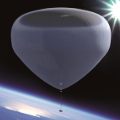
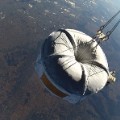
Two companies are racing to take passengers to near space using helium balloons. Pictured, a rendering of a World View balloon.
Hide Caption
Tomorrow Transformed explores innovative approaches and opportunities available in business and society through technology.
(CNN)Instead of rocket-powered sub-orbital flights like those of Virgin Galactic, could high-altitude ballooning become the most viable way of letting paying tourists experience space — or at least something thrillingly close to it?
Ballooning is already tried and tested technology — “It’s the origin of space travel,” explains Annelie Schoenmaker, external relations and legal officer for Zero2infinity, a Spanish company that plans to launch passengers to near space using balloons known as “Bloons” for €110,000 ($124,000) a time.
Zero2infinity is one of two organizations hoping to use pressurized capsules suspended beneath helium balloons as a way to take tourists into near space.
Flights using helium-filled balloons began in the early 1930s. “For me this time was what I call the first space race, as it was the first time we went into the stratosphere,” explains Dr Jonathan Clark, an associate professor in neurology and space medicine, who has advised on both Red Bull Stratos and StratEx — the project that saw Google executive Alan Eustace make a record-breaking space dive, assisted by ballooning company World View Enterprises.
“Even the first spacesuits were tested using balloons,” adds Schoenmaker. To this day ballooning is hugely important for space science; NASA and other commercial companies use balloons as an inexpensive means to test payloads in near-space environments.
Because balloons can spend a relatively large amount of time in the stratosphere, this “gives increased observation and experiment runs,” explains Jane Poynter, CEO of World View, which will offer near-space ballooning trips for $75,000. High-altitude ballooning even has some high-profile fans within the space community, including veteran of four space shuttle missions, Mark Kelly, who works with World View as director of flight crew operations.
‘A totally different experience’
Of course, it’s not actually space — balloons only travel to a height of between 30-40km, with 36km being seen as optimum; to reach what is defined as space, you need to travel to a height of 100km. “But it is pretty close and it gives you a totally different experience,” says Michael Lopez-Alegria, former NASA astronaut and president of the Commercial Spaceflight Federation.
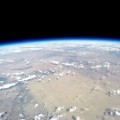
You are still high enough that you are above 99% of the Earth’s atmosphere and although you don’t experience weightlessness, you are able to see something that most humans haven’t — the “Thin Blue Line” of the Earth’s atmosphere. Passengers would also be able to see the Earth in the blackness of space, as well as the sun rise over the curvature of the planet.
“Our goal is to provide as many people as possible with a perspective-changing view of our planet” adds Poynter.
The science behind sending humans to the edge of space is much the same as sending any other payload. “It’s very easy,” says Schoenmaker, “put in helium, release the balloon and up it goes, very slowly.”
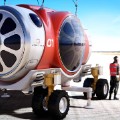
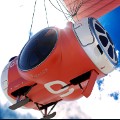
The capsules are completely sealed, allowing for full pressurization at altitudes. “Our capsule is fitted with state-of-the-art space-rated life support systems, designed and manufactured by Paragon Space Development Corporation, who are global leaders in life support technology,” says Poynter, of the World View system.
Slow ride
Balloons can in theory launch from anywhere in the world, as long as the weather is favorable. Unlike rockets, there is no big acceleration, with a balloon taking between 1.5-2 hours to reach maximum altitude. Once there, inside a capsule attached to the balloon, crew and passengers can bob along on the edge of our atmosphere for up to two hours. Once built, both the Bloon and World View cabins will have toilet facilities and you’ll even be able to dine on board.
World View plans to take six passengers and two crew at a time, while Bloon hopes to take up to four passengers and two crew, though the role of the crew is described by Schoenmaker “as more for passenger support and a precaution if something goes wrong.”
To return to Earth, helium is vented from the balloon, then a ParaWing, which is already deployed, takes over the remainder of the descent. Schoenmaker explains: “For safety, we also have a further two back-up chutes.” The descent back to Earth takes around an hour, meaning there is no big acceleration, with the capsule landing in a predetermined location, guided back to Earth by a pilot and the support of mission control.
The ultimate aim for near-space ballooning is that the experience will be comparable to getting on a commercial airliner. Passengers would be inside a pressurized environment, just like on a plane. However, whether passengers would still need to wear spacesuits will depend on certification from authorities. As with other forms of commercial space travel, in the United States balloons to the stratosphere are regulated by the FAA (Federal Aviation Authority), under the Office of Commercial Space Transportation — although for flights in Europe, regulation is not yet defined.
Safety first
As with all forms of commercial space experiences, safety is a huge factor in determining when paying passenger flights will realistically take place. “We will not launch until we are completely satisfied and confident with our testing,” explains Poynter. In late February, World View announced it had successfully flown a parafoil from a height of 102,000 feet (31 kilometers). With extensive unmanned testing already underway, the hope for World View is that it could launch as soon as the end of 2016, with Bloon expecting to begin flights in the next few years.
But because the balloons don’t go to space, is there actually interest for this type of experience? “Space ballooning certainly has its market,” believes Brad Inggs, CEO of Orbital Horizon, a space support and intelligence solution agency, based in South Africa. “Once launches become regular, it will catch the interest of people seeking that kind of experience.” Schoenmaker claims that there is already a waiting list for trips on Bloon, but says they cannot disclose numbers.
There is also scope for high-altitude balloons to further benefit life on Earth. “Earth observation and communication payloads on board balloons can also assist in disaster relief,” says Inggs. And balloons could also be used to launch nanosatellites from high altitude, reducing the cost of launch.